
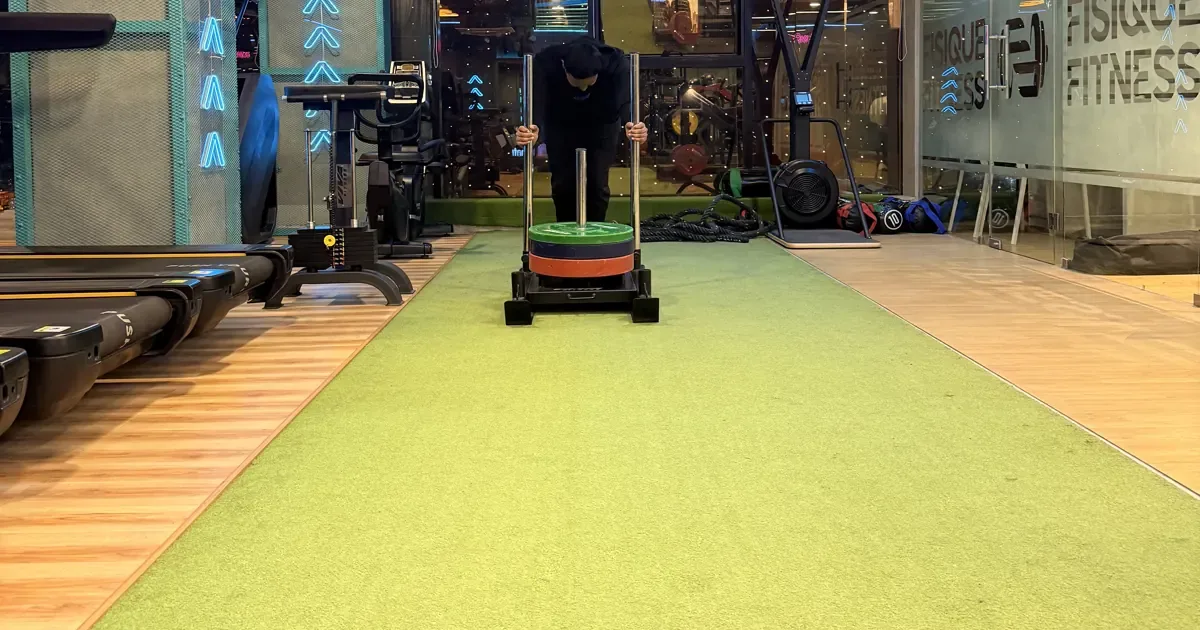
You do not need a purpose-built race facility to prepare for a HYROX-style event. A regular gym with a rower, a few dumbbells or kettlebells, a bar, a box and a wall ball covers most of it. The missing pieces, a proper sled and a ski machine, have decent substitutes, and the rest is a well-built week.
It suits anyone in Hyderabad training for that format: eight rounds of running plus a station. It is also the same engine-plus-strength base that serves long-term health, so none of it is wasted if you never enter a race. To be clear, HYROX is a separate race organisation, and Fisique is not affiliated with it. What we offer is coached hybrid race training in Kokapet, in the same spirit.
The format you are preparing for
As published by the organisers at hyrox.com, a HYROX race is eight rounds. Each round is a 1 km run followed by one station, always in the same order:
- SkiErg 1000 m
- Sled push 50 m
- Sled pull 50 m
- Burpee broad jumps 80 m
- Rowing 1000 m
- Farmers carry 200 m
- Sandbag lunges 100 m
- Wall balls, 100 reps
In the Open division the sled push is 152 kg for men and 102 kg for women, the sled pull 103 kg and 78 kg, the farmers carry 2 x 24 kg and 2 x 16 kg, the sandbag 20 kg and 10 kg, and the wall ball 6 kg and 4 kg. We go through the format in more detail in what HYROX is and where to race from Hyderabad. There is no race in Hyderabad at the moment, so Mumbai in September and Bengaluru are the nearest options for Hyderabad athletes.
Equipment substitutions that work
Match the movement and the demand, not the brand of machine.
| Station | If you have it | Regular gym substitute |
|---|---|---|
| SkiErg | SkiErg | Cable straight-arm pulldowns plus a rower or air bike for the engine; short intervals on the rower at a harder rate |
| Sled push | Sled on turf | Prowler-style push if available; otherwise heavy leg press for strength and a loaded walking lunge or steep incline walk |
| Sled pull | Sled and rope | Seated cable row heavy, plus backward walking drags with a band or a weight plate on a rope |
| Burpee broad jumps | Open floor | The same movement on a patch of floor, marked in metres |
| Rowing | Rower | Rower, which almost every gym has |
| Farmers carry | Handles or kettlebells | Heavy dumbbells or kettlebells, any corridor |
| Sandbag lunges | Sandbag | Dumbbell goblet lunges or a loaded rucksack on the shoulders |
| Wall balls | Wall ball and target | Thruster with a dumbbell, or a medicine ball against any wall with a taped line |
A substitute is never identical. A heavy leg press does not teach you to keep driving on a moving sled. So if you can, book a few sessions on the real thing in the final six weeks before a race.
Run first, then build the stations around it
Half of the race is running, and it is running on tired legs. If you only train stations, the 1 km repeats will find you out. Most people are better served by a steady run base first, usually two or three short runs a week, before piling on station volume.
Treadmill is fine. If you run outdoors in Hyderabad, plan around the heat: early morning or after sunset is kinder, and during the monsoon, keep a treadmill option so one wet week does not erase your base.
A weekly template for a regular gym
This is a starting point for someone training four to five days a week, not a prescription. Adjust for your level, injury history and schedule.
- Day 1, lower strength: squat or leg press, Romanian deadlift, split squat, calf raises. Finish with 10 minutes of easy rowing.
- Day 2, easy run: 30 to 45 minutes at a pace where you can talk. Add 4 to 6 short strides at the end.
- Day 3, upper strength and carries: row, press, pull-up or pulldown, then 4 rounds of a heavy farmers carry.
- Day 4, interval day: 5 to 6 repeats of 3 to 4 minutes hard on the treadmill or rower, with equal easy recovery.
- Day 5, race-style session: 4 to 5 rounds of a run (400 to 800 m) followed by a single station, at a pace you could repeat.
- Day 6 or 7: rest, or an easy walk, mobility and sleep.
Every second or third week, swap the race-style session for a longer one that runs through more of the stations in order, at a controlled pace. That is where you find out which station is your weak link.
The two stations most gyms cannot copy
Sled push and sled pull are the hard ones to replicate. The principle is simple: heavy, slow, continuous. Our full guide to sled push and sled pull covers technique and load progression. If you cannot find a sled, put your effort into heavy leg strength and heavy rowing, and book a session with a real sled before race week.
Where a coached setup helps
At Fisique in Kokapet we have turf for pushing and pulling a sled, rowers and the free weights to build the rest. Each session is one-on-one for an hour, so your coach can adjust loads on the day and spot technique drift when you are tired. We use the same approach for the Yoddha Race, which has a similar structure: about 5 km of running with seven stations, and a finish under 90 minutes earns the Yoddha Medal. If you want to see that format, read what the Yoddha Race is.
Train this way and you build two things at once: a body that can handle the race and a body that is stronger, fitter and more resilient for decades. Hybrid training is the race-prep method and the healthspan base at the same time.
Common mistakes in a regular gym
- All strength, no running. The runs are half the race. Protect them.
- Doing every session at race pace. Most of your week should be controlled. Two hard days are enough.
- Skipping the weak station. If wall balls are your problem, train them every week, not once a month.
- Adding load and volume together. Raise one at a time, then the other.
- Ignoring recovery. Sleep and one real rest day decide whether the plan works.
Build volume slowly. Three sessions a week of mixed running and strength is plenty for most beginners, and the jump from a quiet month to a full race-style week is where overuse niggles start. If a joint complains for more than a day or two, back off the load and ask a qualified professional to look at it. Hybrid training rewards the person who is still training in a year, not the one who peaked in a fortnight.
Train with us
If your gym has no sled or turf, coached sessions at Fisique in Kokapet cover the stations you cannot copy and the week around them, for a HYROX-style race, the Yoddha Race or no race at all. Message us on WhatsApp for plans, or see Yoddha Race training and personal training in Kokapet.